First, create a path where none exists.
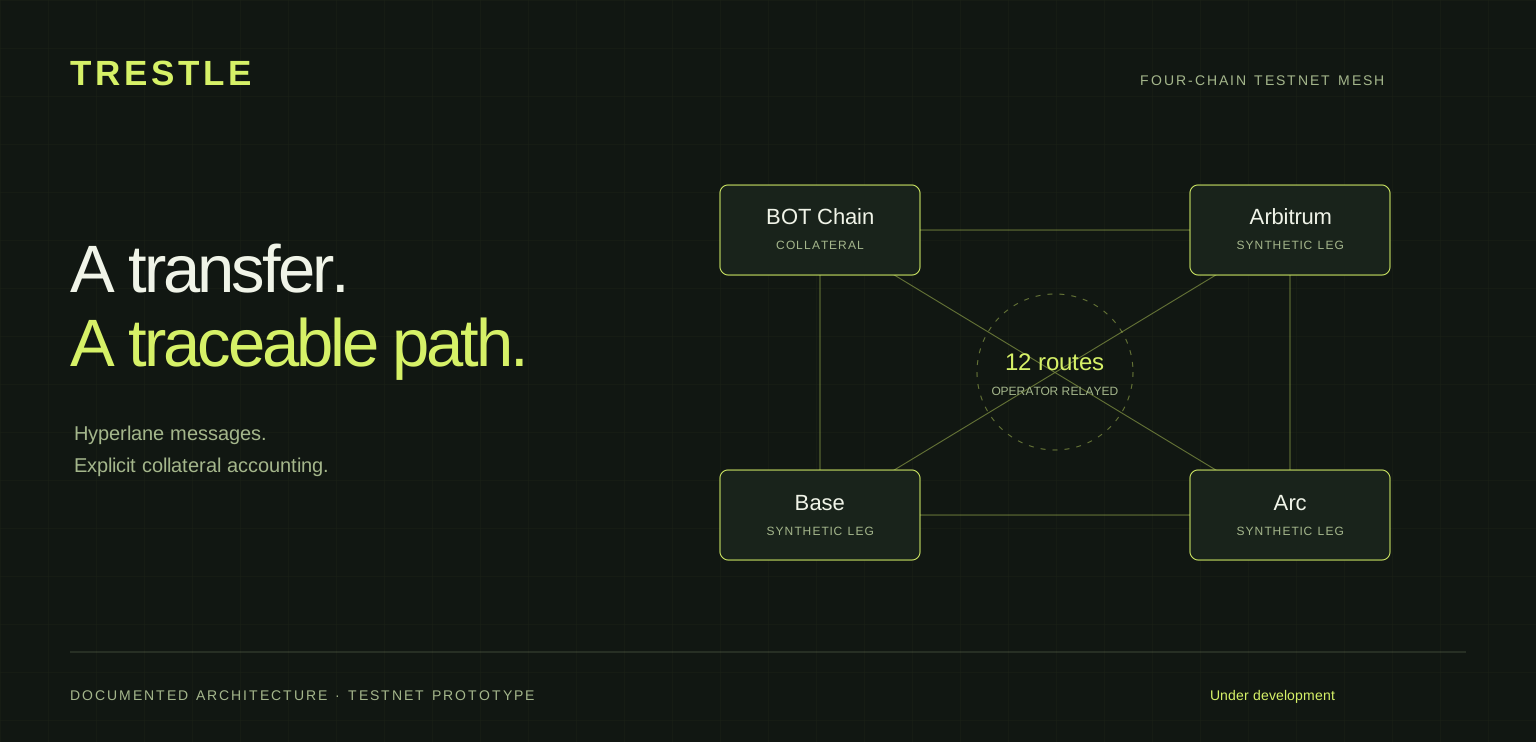
The build deployed Hyperlane core on BOT Chain testnet and later on Arc testnet. Arbitrum and Base used existing core deployments. Collateral stays on BOT while synthetic botUSDT moves through the remote legs.
Cross-chain infrastructure · Nuvixes
A four-chain testnet USDT bridge built around Hyperlane messaging, explicit collateral accounting, and inspectable transfer receipts.
Why this exists
A transfer should not disappear into a spinner between chains. Trestle began with a concrete gap: extending BOT Chain's testnet USDT routes while keeping the message path, destination, and accounting visible.
The build deployed Hyperlane core on BOT Chain testnet and later on Arc testnet. Arbitrum and Base used existing core deployments. Collateral stays on BOT while synthetic botUSDT moves through the remote legs.
Adding chains created a full mesh of twelve directed routes. It also exposed a stale accounting check: comparing locked collateral with the Arbitrum supply alone stopped making sense once another chain held tokens. The invariant had to include every synthetic leg.
The September 16 inspection tightened relayer scope to Trestle-router messages, refreshed wallet network checks, and corrected full-mesh configuration. On September 21, health checks gained retries because intermittent Arc RPC rate limits could look like accounting failures. The build had to distinguish a real mismatch from an unreliable read.
Build journal
Recorded milestones from the build. Dates describe these events, not the entire project history.
The dated handoff records the four-chain UI, twelve routes, accounting-check correction, and relayer-scope fixes.
A repository commit added retries around collateral-invariant reads while preserving genuine failure reporting.
Where it stands
A working testnet bridge with documented transfer receipts. Messages are accepted through an operator-controlled trusted relayer; remote botUSDT is synthetic. This is not a production bridge for real funds.
The next chapter
Replace the testnet trust model, isolate signing, add operational protections, and obtain independent security review before production use.
Based on the public Trestle README, September 16 handoff, and September 21 health-check commit. Receipts are repository evidence, not independently reverified here.